MettleSense Lean · Athlete Body Intelligence
A research-led body intelligence system that integrates nutrition, training load, glycogen, hydration and recovery signals to interpret short-term weight fluctuations using evidence-informed models. It logs food from natural language, models likely weight movement and tracks recovery patterns against individual physiology and longitudinal data.
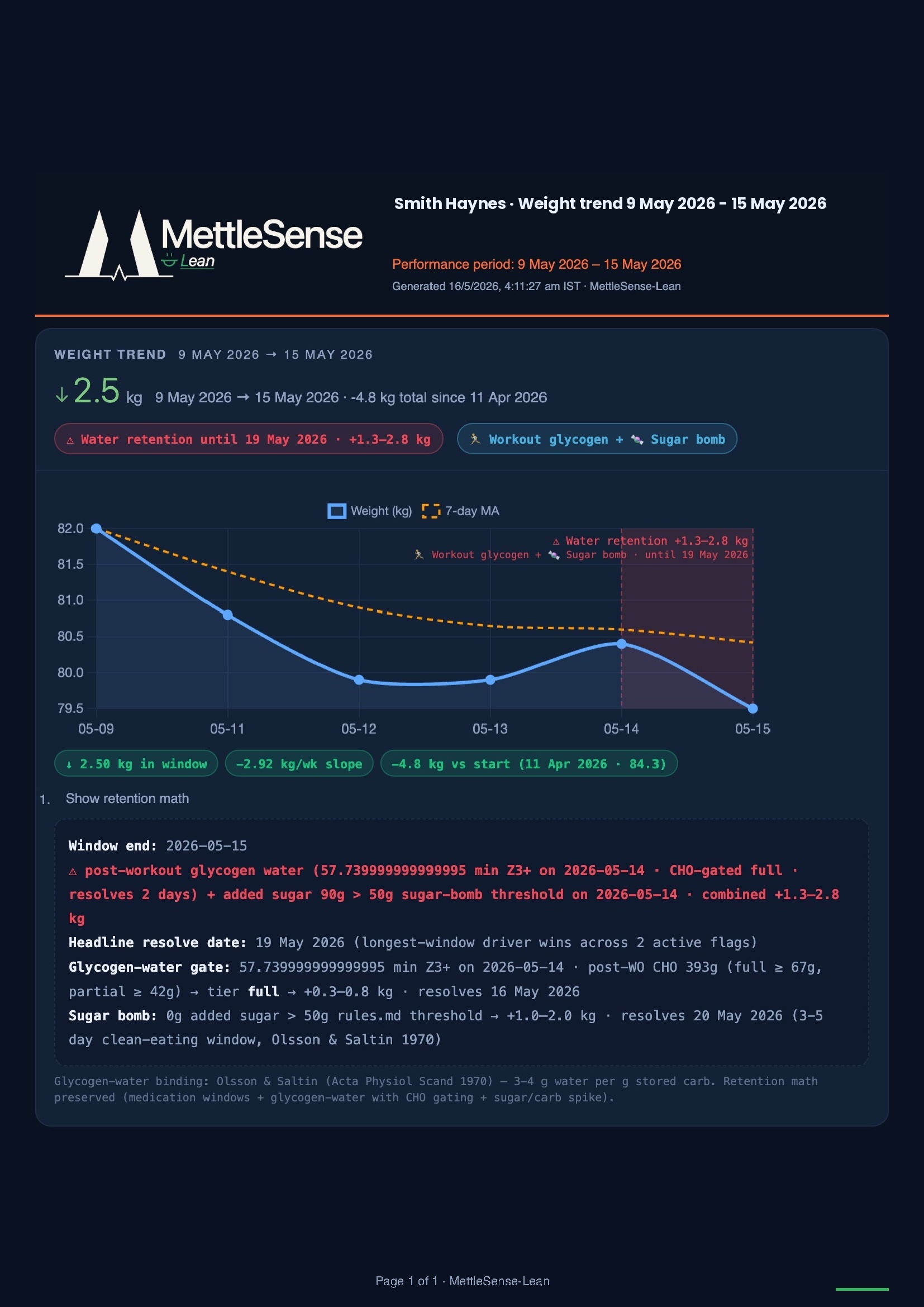
Added sugar above 50g/day triggers the Sugar Bomb flag. The mechanism, cited: 150g glycogen repletion × 3g water per gram of glycogen = ~450g water spike on the scale.
Olsson & Saltin, 1970 · Acta Physiologica Scandinavica
AHA warning badge fires earlier — 36g for men, 25g for women. You see the badge before the scale moves. Not after. American Heart Association, 2016 · Circulation
Clean eating resolve window. Added sugar >50g/day.
Total carbs >220g, non-sugar-bomb.
+0.3–0.8 kg after a Z3+ training session ≥15 min.
Tracked individually against your medication reference sheet.
Some medications cause clinically documented water or weight retention. Lean tracks each individually — with the mechanism, expected magnitude, and the estimated resolution window.
Sodium retention via mineralocorticoid effect. e.g. Prednisone, Dexamethasone. Magnitude scales with dose and duration.
COX inhibition → reduced renal prostaglandin → sodium + water retention. e.g. Ibuprofen, Naproxen.
H1-blockade reduces fluid mobilisation in some users. Mild effect. e.g. Cetirizine, Loratadine.
Oestrogen upregulates aldosterone via the RAAS axis → cyclical water retention of 0.5–2 kg.
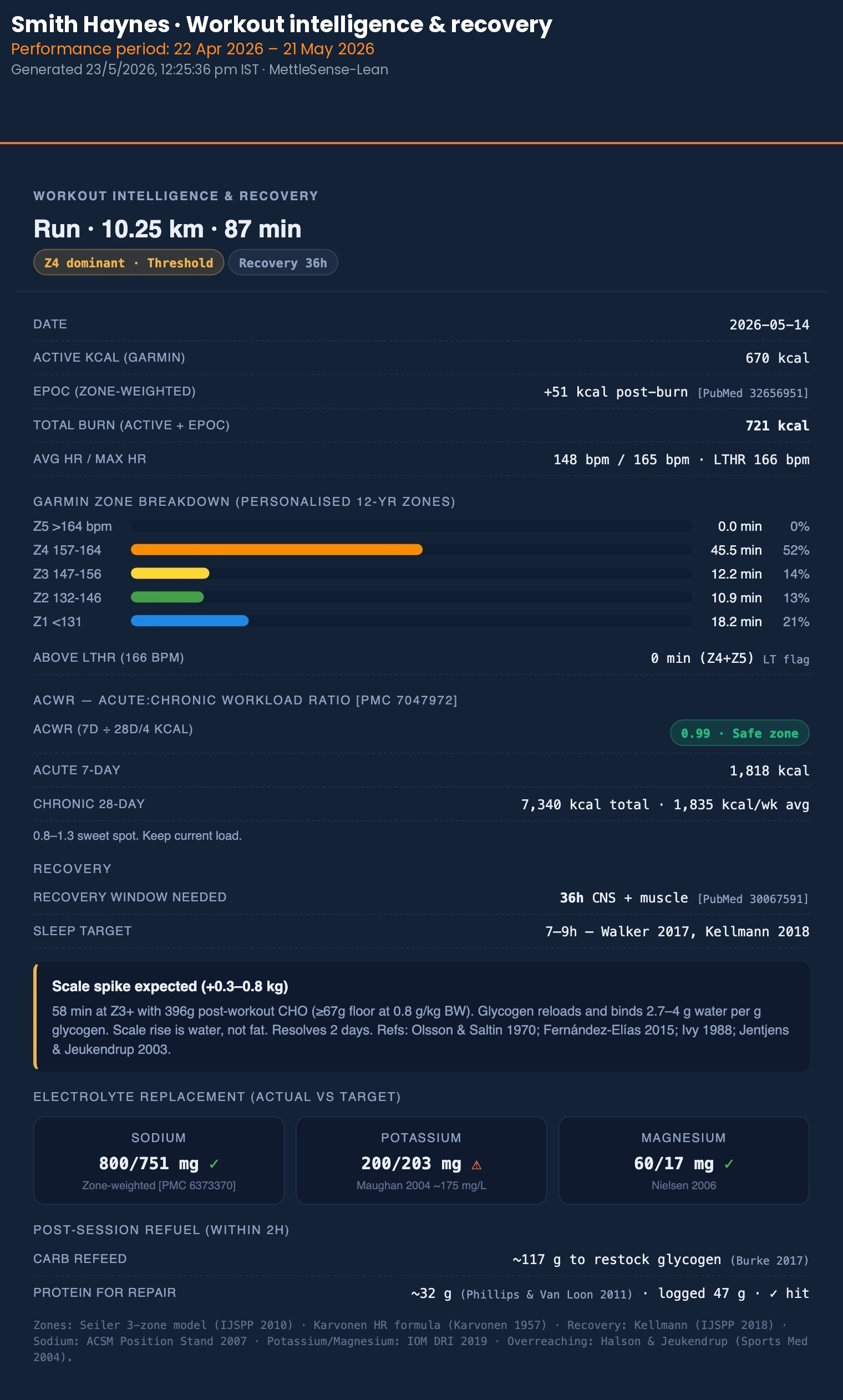
EPOC by zone, ACWR workload ratio, sodium sweat loss, glycogen window — computed from your actual session data, not population estimates. Run 10.25 km, 87 min. Every number cited.
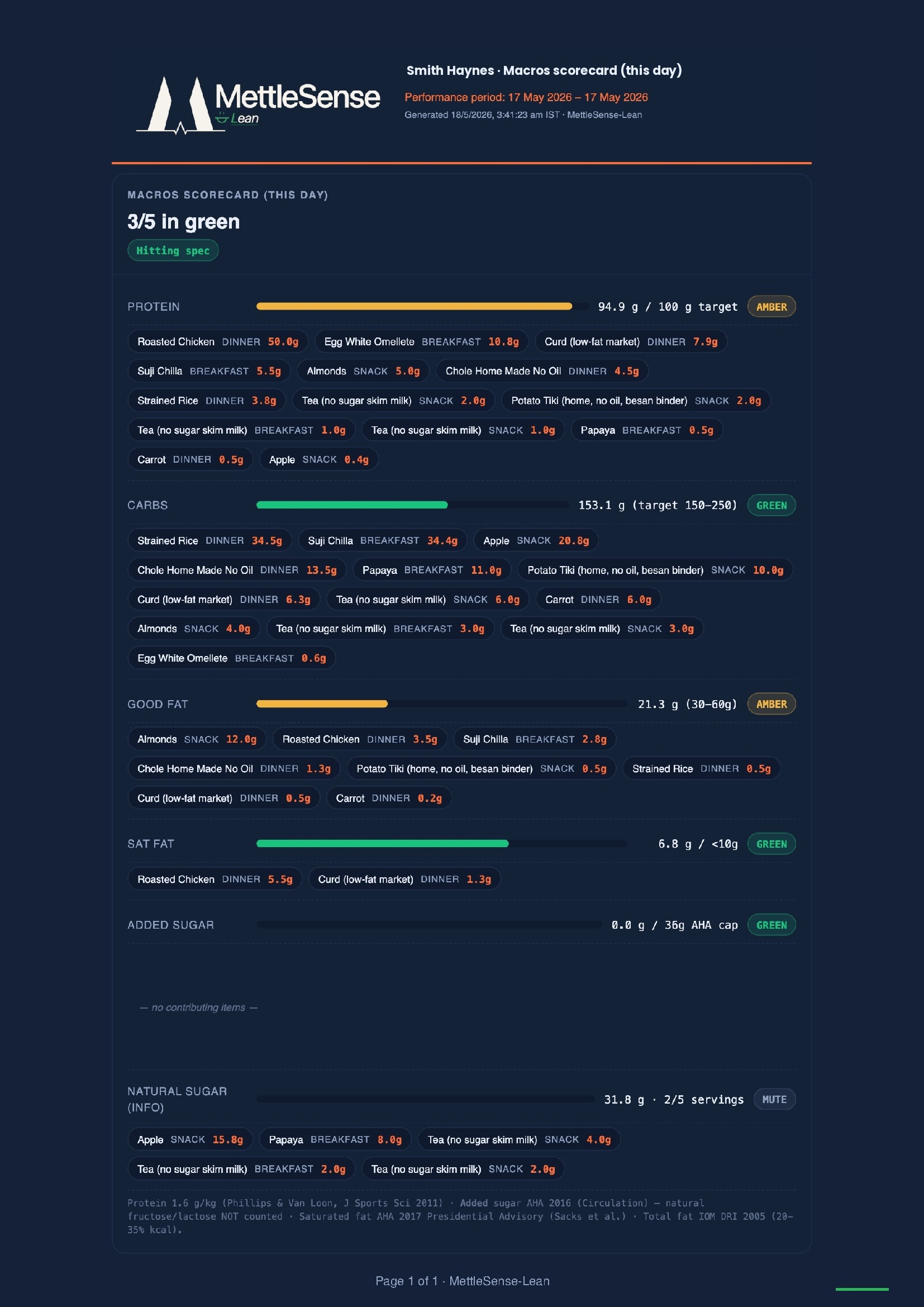
Type: "suji chilla 125g, 2 cups chai, 1 apple" — Lean logs it. One call. Done.
Levenshtein + SequenceMatcher + Double Metaphone phonetic matching. Typos, regional spellings, phonetic variants — all resolved.
chai→tea · dahi→curd · pohe→poha · badam→almonds · mangoo→mango · penar burj→paneer bhurji.
Fires at 06:00 every morning. Hot-item cache resolves your 50 most frequent foods in O(1). The more you log, the faster it gets.
IFCT 2017 for every Indian food. USDA FoodData Central for Western foods. No "curry — 200 kcal" placeholders.
Z1: 3% · Z2: 5% · Z3: 8% · Z4: 10% · Z5: 13% of active kcal.
Z1/Z2: 12h · Z3: 24h · Z4: 36h · Z5: 48h.
7-day kcal ÷ (28-day kcal ÷ 4). Reference range: 0.8–1.3 · Elevated load: 1.3–1.5 · High load: >1.5.
Sweat loss: Z1 300 mg/hr → Z5 800 mg/hr. Pulled from food log. No manual entry.
Roti. Dal. Rajma. Chole. Paneer bhurji. Suji chilla. Paratha. Curd. Soya nuggets. Papaya. Pistachios. Every item sourced from IFCT 2017. Every macro citation-traceable. No generic Indian food bucket.
Lean uses your personal Garmin zones, calibrated from your lactate threshold heart rate. Your physiology. Your 12-year data. Every EPOC and recovery calculation reflects that.
Interested in this research, technical collaboration, or exploring the potential of this project? Feel free to get in touch.
research@mettlesense.com